Friday, January 15, 2021

Acts 16:7 -


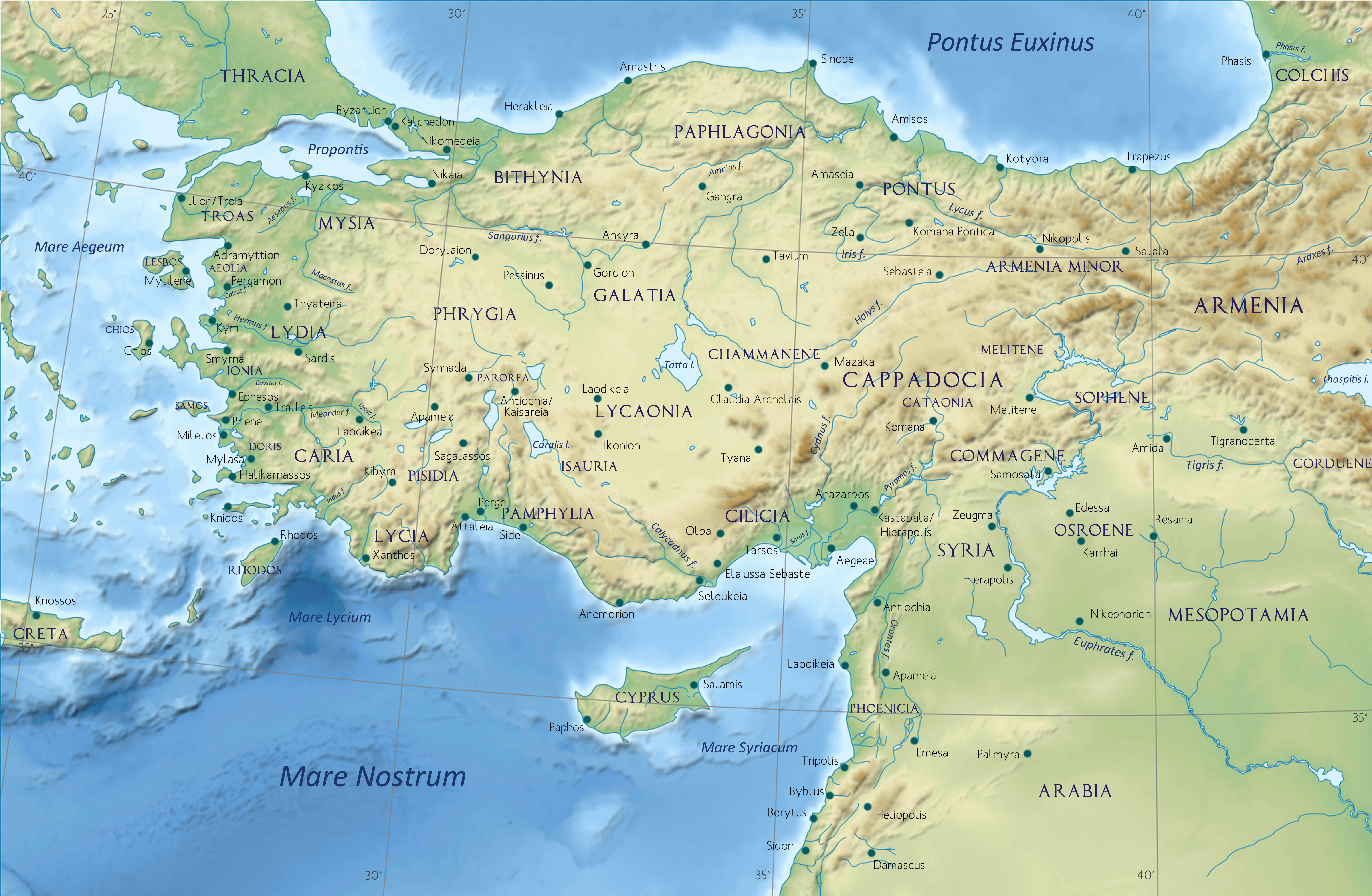
 https://upload.wikimedia.org/wikipedia/commons/b/b0/Asia_Minor_in_the_Greco-Roman_period_-_general_map_-_regions_and_main_settlements.jpg


MYSIAmish'-i-a (Musia): A country in the northwestern part of Asia Minor, which formed an important part of the Roman province of Asia. Though its boundaries were always vague, it may be said to have extended on the North to the Sea of Marmora on the East to Bithynia and Phrygia, on the South to Lydia, and on the West to Hellespont. According to some authors it included the Troad. Its history is chiefly that of important cities, of which Assos, Troas, and Adramyttium on the border of Lydia, are mentioned in the New Testament. When Mysia became a part of the Roman province of Asia in 190 B.C., its old name fell into disuse, and it was then generally known as the Hellespontus. According to Acts 16:7, 8, Paul passed through the country, but without stopping to preach, until he reached Troas on the coast, yet tradition says that he founded churches at Poketos and Cyzicus. Onesiphorus, who was martyred some time between 109 and 114 A.D., during the proconsulate of Adrian, is supposed to have evangelized this part of Asia. See The Expository Times, IX, 495  

 -----------------------------------------------------------------------------

Psalm 19:8

The law of the Lord is perfect. 


---------------------------------------------------------------------------
 
                        Ketuvim Neviim Torah
 

-------------------------------------------------------------------------
 
What is halakha law?
Halakhah, (Hebrew: “the Way”) also spelled Halakha, Halakah, or Halachah, plural Halakhahs, Halakhot, Halakhoth, or Halachot, in Judaism, the totality of laws and ordinances that have evolved since biblical times to regulate religious observances and the daily life and conduct of the Jewish people.
 
Orthodox Judaism holds that halakha is the divine law as laid out in the Torah (five books of Moses), rabbinical laws, rabbinical decrees, and customs combined.
 
---------------------------------------------------------
 
 John 14:6 I am the Way

Alternative forms

Etymology

From Proto-Indo-European *sodos, from *sed- (“to sit”). Cognates include Old Church Slavonic ходъ (xodŭ) and Sanskrit सादस् (sādas, “a sitting, riding, motion”).

For the semantic development, compare English road from Proto-Germanic *raidō (“ride, journey”), from Proto-Germanic *rīdaną (“to ride”).

Pronunciation

 
  • IPA(key): /ho.dós/ → /oˈðos/ → /oˈðos/

Noun

ὁδός • (hodós) f (genitive ὁδοῦ); second declension

  1. threshold
  2. road, path, way
    Synonym: οὔθα (oútha)
  3. journey, trip, expedition
  4. The way, means, or manner to some end, method


--------------------------------------------------------------------------------------------------------------------- 

1 Corinthians 9: 19 -23

19 Although I am a free man and not anyone’s slave, I have made myself a slave to everyone, in order to win more people. 20 To the Jews I became like a Jew, to win Jews; to those under the law, like one under the law—though I myself am not under the law[c]—to win those under the law. 21 To those who are without that law, like one without the law—not being without God’s law but within Christ’s law—to win those without the law. 22 To the weak I became weak, in order to win the weak. I have become all things to all people, so that I may by every possible means save some. 23 Now I do all this because of the gospel, so I may become a partner in its benefits.[d]


-------------------------------------------------------------------------------------------------------------------- 


hupomoné: a remaining behind, a patient enduring
 

Original Word: ὑπομονή, ῆς, ἡ
 

Part of Speech: Noun, Feminine
Transliteration: hupomoné
Phonetic Spelling: (hoop-om-on-ay')
Definition: a remaining behind, a patient enduring
Usage: endurance, steadfastness, patient waiting for.

-------------------------------------------------------------------------------------------------------------------

1 Corinthians 2:6-8

6 However, we do speak a wisdom among the mature, but not a wisdom of this age, or of the rulers of this age, who are coming to nothing. 7 On the contrary, we speak God’s hidden wisdom in a mystery, a wisdom God predestined before the ages for our glory. 8 None of the rulers of this age knew this wisdom, for if they had known it, they would not have crucified the Lord of glory.

----------------------------------------------------------

 
2 Timothy 1:5

1 Paul, an apostle of Christ Jesus by God’s will, for the promise of life in Christ Jesus:

2 To Timothy, my dearly loved son.

Grace, mercy, and peace from God the Father and Christ Jesus our Lord.

Thanksgiving

3 I thank God, whom I serve with a clear conscience as my ancestors did, when I constantly remember you in my prayers night and day. 4 Remembering your tears, I long to see you so that I may be filled with joy, 5 clearly recalling your sincere faith that first lived in your grandmother Lois, then in your mother Eunice, and that I am convinced is in you also.

6 Therefore, I remind you to keep ablaze[a] the gift of God that is in you through the laying on of my hands. 7 For God has not given us a spirit[b] of fearfulness, but one of power, love, and sound judgment.

Not Ashamed of the Gospel

8 So don’t be ashamed of the testimony about our Lord, or of me His prisoner. Instead, share in suffering for the gospel, relying on the power of God.

 ----------------------------------------------------------

20 For I have no one else like-minded who will genuinely care about your interests; 21 all seek their own interests, not those of Jesus Christ. 22 But you know his proven character, because he has served with me in the gospel ministry like a son with a father.


Monday, January 4, 2021

Acts 15:36 -


1 Corinthians 1:10-17

Divisions at Corinth

10 Now I urge you, brothers, in the name of our Lord Jesus Christ, that all of you agree in what you say, that there be no divisions among you, and that you be united with the same understanding and the same conviction. 11 For it has been reported to me about you, my brothers, by members of Chloe’s household, that there is rivalry among you. 12 What I am saying is this: Each of you says, “I’m with Paul,” or “I’m with Apollos,” or “I’m with Cephas,” or “I’m with Christ.” 13 Is Christ divided? Was it Paul who was crucified for you? Or were you baptized in Paul’s name? 14 I thank God[a][b] that I baptized none of you except Crispus and Gaius, 15 so that no one can say you were baptized in my name. 16 I did, in fact, baptize the household of Stephanas; beyond that, I don’t know if I baptized anyone else. 17 For Christ did not send me to baptize, but to evangelize—not with clever words, so that the cross of Christ will not be emptied of its effect.


--------------------------------------------

Rewards

Matthew 6:1 HCSB

6 “Be careful not to practice your righteousness[a] in front of people, to be seen by them. Otherwise, you will have no reward from your Father in heaven. 2 So whenever you give to the poor, don’t sound a trumpet before you, as the hypocrites do in the synagogues and on the streets, to be applauded by people. I assure you: They’ve got their reward! 3 But when you give to the poor, don’t let your left hand know what your right hand is doing, 4 so that your giving may be in secret. And your Father who sees in secret will reward you.[b]


 1 Corinthians 3:13 HCSB

 10 According to God’s grace that was given to me, I have laid a foundation as a skilled master builder, and another builds on it. But each one must be careful how he builds on it. 11 For no one can lay any other foundation than what has been laid down. That foundation is Jesus Christ. 12 If anyone builds on that foundation with gold, silver, costly stones, wood, hay, or straw, 13 each one’s work will become obvious, for the day[f] will disclose it, because it will be revealed by fire; the fire will test the quality of each one’s work. 14 If anyone’s work that he has built survives, he will receive a reward. 15 If anyone’s work is burned up, it will be lost, but he will be saved; yet it will be like an escape through fire.[g]

-------------------------------------------------------------------------------------------------------------------------- 

John 1:1 The Word


10. The Definite Article is employed in combination with nouns, and is declined in gender, number, and case, to correspond with them.

There is no Indefinite Article in Greek, but its place is often supplied by the Indefinite Pronoun (any, a certain).


The Following forms, which should be carefully committed to memory, afford a general type of the inflections of nouns, adjective, and pronouns, and will therefore be useful in their acquisition.

11. The Definite Article, the. It has first and second declension endings. Note that the nominative masculine and feminine forms of the definite article start with a vowel and not τ, and also note that there are no accents on the vowel. By contrast, the relative pronoun who (ὅς, ἥ, ὅ) has accents on the vowels, but is otherwise spelled the same.

ὁ - the

Singular Plural
Masc. Fem. Neut Masc. Fem. Neut
Nominative ὁ ἡ τό οἱ αἱ τὰ
Genative τοῦ τοϋ τῶν
Dative τῷ τῇ τῷ τοῖς ταῖς τοῖς  
Accusative τόντήντότούςτάςτά


 Koine Greek/10

Saturday, December 12, 2020

Acts 15:30 -


Ecclesia and Synagoga, or Ecclesia et Synagoga in Latin, meaning "Church and Synagogue", are a pair of figures personifying the Church and the Jewish synagogue, that is to say Judaism, found in medieval Christian art. They often appear sculpted as large figures on either side of a church portal, as in the most famous examples, those at Strasbourg Cathedral. They may also be found standing on either side of the cross in scenes of the Crucifixion, especially in Romanesque art, and less frequently in a variety of other contexts.[1]

The two female figures are usually young and attractive; Ecclesia is generally adorned with a crown, chalice and cross-topped staff, looking confidently forward. In contrast, Synagoga is blindfolded and drooping, carrying a broken lance (possibly an allusion to the Holy Lance that stabbed Christ) and the Tablets of the Law or Torah scrolls that may even be slipping from her hand.[2] The staff and spear may have pennants flying from them. In images of the Crucifixion, Ecclesia may hold a chalice that catches the blood spurting from the side of Christ; she often holds the chalice as an attribute in other contexts.[3] Attributes sometimes carried by Synagoga include a sheep or goat or just its head, signifying Old Testament sacrifice, in contrast to Ecclesia's chalice which represents the Christian Eucharist. If not blindfolded, Synagoga usually looks down.[4] Ecclesia has an earlier history, and in medieval art Synagoga occasionally appears alone in various contexts, but the pair, or Ecclesia by herself, are far more common. Further subjects where the pair may sometimes be found are the Tree of Jesse, and the Nativity.[5]


Tefillin (Askhenazic: /ˈtfɪlɪn/; Israeli Hebrew: [tfiˈlin], תְּפִלִּין or תְּפִילִּין) or phylacteries, is a set of small black leather boxes containing scrolls of parchment inscribed with verses from the Torah. Tefillin is worn by observant adult Jews during weekday morning prayers. In Orthodox communities, it is worn only by men, while in non-Orthodox communities, it may be worn by men and women.

Although "tefillin" is technically the plural form (the singular being "tefillah"), it is often used as a singular as well.[1] The arm-tefillah (or shel yad) is placed on the upper arm, and the strap wrapped around the arm, hand and fingers; while the head-tefillah (or shel rosh) is placed above the forehead. It is intended to fulfill the Torah's instructions to keep as a "sign" and "remembrance" of the Exodus, signifying that God brought the children of Israel out of Ancient Egypt.


https://upload.wikimedia.org/wikipedia/commons/0/02/SadhuSundarSingh.jpg

Sadhu Sundar Singh

From Wikipedia, the free encyclopedia

Jump to navigation Jump to search This article is about the Indian Christian, disciple of Christ.


Sadhu Sundar Singh 

Conversion to Christianity

Sundar felt that his religious pursuits and the questioning of Christian priests left him without ultimate meaning. Sundar resolved to kill himself by throwing himself upon a railroad track. He asked that whosoever is the 'True God' would appear before him, or else he would kill himself; that very night he had a vision of Jesus. Sundar announced to his father, Sher Singh, that henceforth he would get converted into the missionary work of Christ. His father officially rejected him, and his brother Rajender Singh attempted to poison him. He was poisoned not just once but a number of times. People of that area threw snakes in his house, but he was rescued from mistreatment by the help of a nearby British Christian.[5]

On his sixteenth birthday, he was publicly baptised as a Christian in the parish church in Simla,[4] in the Himalayan foothills. Prior to this he had been staying at the Christian Missionary Home at Sabathu, near Simla, serving the leprosy patients there.

----------------------------------------------------------------------------------------------------


A Living Library of Jewish Texts ספרייה חיה של טקסטים יהודיים

Explore 3,000 years of Jewish texts in Hebrew and English translation. Learn More ›


https://www.sefaria.org/


Ancient Hebrew Texts ,English Translations 

----------------------------------------------------------------------------------------------------


Friday, November 27, 2020

Greek Noun Declensions

Nouns in Greek are declined  


Koine Greek/4. Introduction to Nouns

Jump to navigation Jump to search

Nouns in Greek are declined (have ending changes) based on case, number (singular or plural), and gender (masculine, feminine, neuter).

The case of a noun indicates the function of the noun in the sentence. There are five different cases:

  1. The nominative case marks the subject of a phrase as well as the predicate nominative (i.e., the object of a linking verb (or copulative verb), such as to be). Examples: In the sentence "The dog bit the man", dog would be in the nominative case. Also, in the sentence "The man is a soldier", both "man" and "soldier" are in the nominative case.
  2. The genitive case denotes source or origin (this function is also called the ablative), or kind or possession. It is also often used for an object of a preposition. It is frequently translated as "of ...". Examples: In the phrase "The man's wife", or equivalently, "the wife of the man", man would be in the genitive case.
  3. The dative case denotes an indirect object (translated as "to ..." or "for ..."); means or agency, especially impersonal means (translated as "by ..."); or a location. It is also frequently used as an object of a preposition, and often, a preposition can take a noun in either the genitive or dative case with different meanings. Examples: In the sentence "I spoke to John", John would be in the dative case. Also, in the sentence "By grace, you have been saved", grace would be in the dative case.
  4. The accusative case denotes a direct object. Example: In the sentence, "I saw the cat", cat would be in the accusative case.

In Greek, nouns fall under three different patterns for case endings, called declensions. The first declension contains nouns whose stems end in α or η. They are mostly feminine nouns. The second declension contains nouns whose stems end in ο. They are mostly masculine or neuter. The third declension contains all other nouns (mostly, nouns whose stems end in a consonant). There are broad patterns in third declension endings, but many more special cases than for first and second declension nouns.


Friday, July 17, 2020

Acts 13:3 -

https://en.wikipedia.org/wiki/Seleucia_Pieria

Seleucia Pieria

From Wikipedia, the free encyclopedia
Jump to navigation Jump to search
Seleucia in Pieria
Roman Sarcophagus, Seleucia Pieria.jpg
A Roman sarcophagus on the upper hills of the city
Seleucia Pieria is located in Turkey
Seleucia Pieria
Shown within Turkey
LocationHatay Province, Turkey
RegionLevant
Coordinates36°07′26″N 35°55′19″ECoordinates: 36°07′26″N 35°55′19″E
TypeSettlement
History
BuilderSeleucus I Nicator
Founded300 BC
PeriodsHellenistic to Medieval
CulturesGreek, Roman, Arab, Turkish
Site notes
ConditionIn ruins

Seleucia in Pieria (Greek Σελεύκεια ἐν Πιερίᾳ), also known in English as Seleucia by the Sea, and later named Suedia, was a Hellenistic town, the seaport of Antioch ad Orontes (Syria Prima), the Seleucid capital, modern Antakya (Turkey). The city was built slightly to the north of the estuary of the river Orontes, between small rivers on the western slopes of the Coryphaeus, one of the southern summits of the Amanus Mountains.

According to Pausanias and Malalas, there was a previous city here named Palaeopolis ("Old City"). At present, it is located at the seaside village of Çevlik[1] near the town of Samandağ in the Hatay Province of Turkey. Seleucia, Apamea, Laodicea, and Antioch formed the Syrian tetrapolis.[2]

History

Seleucid period

Seleucia Pieria was founded in ca. 300 BC by Seleucus I Nicator, one of the successors of the Macedonian conqueror Alexander the Great and the founder of the Seleucid Empire.[3] The Macedonians called the landscape Pieria, after a district in their homeland that was also between the sea and a mountain range (the Olympus).[3]

When Seleucus I was murdered on his way to Macedon in 281 BC, his son, Antiochus I, buried his ashes in a building called "Nikatoreion", situated on Seleucia.

The city was of great importance in the struggle between the Seleucids and the Ptolemies; it was captured by Ptolemy Euergetes in 246 BC.[2] As the Ptolemies (Lagids) and Seleucids fought over the city, it changed hands several times until 219 BC, when the Seleucid Antiochus III the Great recaptured it during the Fourth Syrian War (219–217 BC) his general Ardys is recorded as having distinguished himself during the siege. Then it obtained its freedom and kept it even to the end of the Roman occupation. It had long enjoyed the right of coinage.[4]

Column plinths of possibly the main/harbour street
silver tetradrachm struck in Seleucia by Caracalla 215–217 AD

Roman period

When the Seleucid Empire was subdued by the Armenian conqueror Tigranes II, Seleucia Pieria resisted. Roman general Pompey the Great restored the Seleucids to power by giving the city to Antiochus I Theos of Commagene, a direct descendant of Seleucus I Nicator and a loyal ally of Rome. Under light Commagene rule, Seleucia enjoyed substantial autonomy, i.e. de facto independence.[3]

Seleucia's importance grew significantly over time, necessitating the enlargement of its harbours several times under Diocletian and Constantius. These harbours, called the "inner" and "outer" harbours, served from time to time the Roman navy.

Most buildings and structures today date from the Roman period.

Byzantine period

During Byzantine times the city went into a steady decline. The silting up of the city's harbours hastened this process. In the fifth century CE the fight to keep them open was finally given up. It suffered severely in the devastating 526 Antioch earthquake.

Islamic period

Seleucia was captured by the Sasanids around 540 CE. While it never recovered as a port-city again, Al-Walid ibn Abd al-Malik, Ummayad Caliph from 705 to 715, built a fortress in the city.[5]

Seleucia Pieria and Christianity

The city was Christianized early. As the port of Antioch of Syria,[2] "Seleucia on sea"—so called to distinguish it from other cities of the same name—is most notable as the precise point of embarkation from which the Apostle Paul [in 45 CE] and Saint Barnabas sailed from this port on their first missionary journeys, as chronicled in the Bible (Acts 13:4).[6] At the end of that same journey he must have made landfall at Seleucia before going to Antioch (see Acts 14:26). His route at the beginning of the second journey was by land and probably bypassed Seleucia (see Acts 15:40–41), though on returning, he must have passed through it again (see Acts 18:22). Once more taking a land route when setting out on his third journey, Paul may have missed Seleucia (see Acts 19:1), and at that journey's end he did not return to Antioch and so missed Seleucia again (see Acts 21:7–8). This means that Paul passed through Seleucia at least three times, and probably several more on pre-missionary visits to Antioch of Syria (see Acts 11:26; 12:25).

The oldest bishop known is Zenobius, present at the Council of Nicaea in 325 CE. Other known bishops include Eusebius, an Arian, and Bizus in the fourth century, with twelve others cited by Le Quien (Oriens Christianus, II, 777–780). In the sixth century CE the Notitia Episcopatuum of Antioch, gives Seleucia Pieria as an autocephalous archbishopric, suffragan of Antioch (Échos d'Orient, X 144); the diocese existed until the tenth century CE, and its boundaries are known (Échos d'Orient, X, 97). For some Roman Catholic titularies see Eubel, Hierarchia catholica medii aevi, I, 468.[4]

Seleucia Pieria was a diocese of the Syriac Orthodox Church in the eighth and ninth centuries CE, three of whose bishops are known. The last-known Syriac Orthodox bishop of Seleucia, Ahron (847/874 CE), is mentioned in the lists of Michael the Syrian. There were also Georgian monastic establishments around Seleucia from the 11th to the 13th centuries.[7]

The city is still a titular see of the Roman Catholic Church, Seleuciensis Pierius; the seat is vacant following the death of the last bishop in 1980.[8]

A section of the Titus Tunnel

Known bishops

  • Eugenius of Seleucia heretical follower of Athanasius, grandson of Empress Theodora[9]
  • Dositheus I[10]
  • Zenobius, present at the Council of Nicaea in 325 CE.
  • Eusebius 350[10]
  • Bizus fl 381
  • Maximus
  • Vasilius of Seleucia, Attendee of Council of Ephesus in 431,[11] supporter of Nestorius.
  • Basil of Seleucia fl 452.
  • Dositheus II fl 553.
  • Gerontius fl 448.
  • Nonus of Seleucia; from about 505 AD, exiled about 521 for heresy.
  • Constantius, a heretic
  • Dyonisis fl 553
  • Antonius,[10]
  • Theodorus
  • Agapoius
  • Nicholas
  • Ahron (847–874 CE).[12]

Greek rite bishops

Latin titular archbishop

Main sites

The upper city, about 13 km in circumference, is still distinguishable. The lower city, smaller than the preceding one, was more thickly populated.[4] Ruins include a necropolis, amphitheatre, citadel, temples, some irrigation works as well as some fortifications.

The highlight of the city is a 1350–1400m-long tunnel/canal complex built during Roman times. It is believed that it was dug to divert the nearby river and prevent the harbour from silting up with time. A further reason is assumed to be to help reduce flooding caused during heavy winter rains. Construction began during the reign of Emperor Vespasian (69–79 CE) continuing mainly during his son Titus's time (79–81 CE).

According to Flavius Josephus, a Roman-Jewish historian (37–ca.100 CE), Jewish slaves were used as workers. These were working under orders of Emperor Titus, who had captured Jerusalem in 70 CE. Other POWs were sent to Rome, where they had to build the Colosseum. According to an inscription, the tunnel/canal was not completely finished until the reign of Antoninus Pius (138–161 CE). The last workers were Roman legionaries.[3]


----------------------------------------------------------------------------------------------------------------

https://en.wikipedia.org/wiki/Sergius_Paulus


    Sergius Paulus

    From Wikipedia, the free encyclopedia
    Jump to navigation Jump to search
    Elymas the sorcerer is struck blind before Sergius Paulus. Painting by Raphael from the Raphael Cartoons.

    Lucius Sergius Paulus or Paullus was a Proconsul of Cyprus under Claudius (1st century AD). He appears in Acts 13:6-12, where in Paphos, Paul, accompanied by Barnabas and John Mark, overcame the attempts of Bar-Jesus (Elymas) "to turn the proconsul away from the faith" and converted Sergius to Christianity.

    A boundary stone of Claudius mentioning Sergius was discovered at Rome in 1887.[1] It records the appointment (AD 47) of the Curators of the banks and the channel of the river Tiber, one of whom was Sergius. Since Paul's journey to Cyprus is usually dated to the first half of the 40s (and some scholars date his visit even earlier), it is thought Sergius may have first served three years as Proconsul at Cyprus, then returned to Rome, where he was appointed curator.[2] Another inscription was discovered in 1887 at Soli, Cyprus, by Luigi Palma di Cesnola which mentions a proconsul Paulus.[3] This inscription was dated to the middle of the first century by D.G. Hogarth.[4] T.B. Mitford noted that based on epigraphic grounds the inscription cannot be dated earlier than this and is probably considerably later.[5] As he is not greeted in Paul's Epistle to the Romans, it is possible he died before it was written.[6]

    Some medieval legends have anachronistically identified Sergius Paulus with Paul of Narbonne.

    Sergius Paulus may have been the first of several successive senators named Lucius Sergius Paullus, of Antioch, Pisidia, including one who was consul suffectus around AD 70, and another who was twice consul, Lucius Sergius Paullus, the father of Sergia Paulla, who married Quintus Anicius Faustus, Legate of Numidia in 198, and had Quintus Anicius Faustus Paulinus, governor of Moesia Inferior between 229 and 232


-----------------------------------------------------------------------------------------------------------------

https://en.wikipedia.org/wiki/Elymas


Elymas

From Wikipedia, the free encyclopedia
Jump to navigation Jump to search

Elymas /ˈɛlɪməs/, also known as Bar-Jesus (Ancient Greek: Βαριεσοῦ, Aramaic: Bar-Shuma‎, Latin: Bariesu), is a Jew in the Acts of the Apostles, chapter 13,[1] in the New Testament. Acts of the Apostles calls him a magus, which the King James Bible here translates as "sorcerer". He is represented as opposing the disciple Paul the Apostle, who is called at this point for the first time with his Roman name, and Barnabas in the city of Paphos on Cyprus, when Sergius Paulus, the Roman Proconsul, wishes to hear Paul and Barnabas speak about Jesus. Because of this opposition, Paul claims that God had decided to make him temporarily blind. A cloud of darkness immediately begins blocking his sight;[2] after this Sergius Paulus is converted to Christianity .[3]

Elymas's intentions for Sergius are unclear, only that he was desperate to keep him from receiving the word about Jesus. Perhaps he had the proconsul's ear and was his advisor on matters of faith. This would make sense as Sergius is obviously learned about Jewish teachings and Elymas is Jewish. The message Paul and Barnabas bring threatens the false-prophet's usefulness to the island's most powerful administrator.

Bar-Jesus received the same curse that Paul himself did: temporary blindness.[4] It is clear from the passage that Bar-Jesus had the ear of the proconsul and was well known throughout the region. He was a self-proclaimed prophet of God[5] who may have had his own religious agenda.

Elymas stirred up a riot of Jews and pagans in Salamina (Salamis) against Barnabas, according to The Golden Legend.[6]

Name

Acts 13:8 says "Elymas the Magus (for so his name is translated) opposed them". "Elymas" is possibly derived from the Arabic ‘alīm "learned" or "wise", and may be used to translate magos.[7] Bar-Jesus means "Son of Joshua" or "Son of Jesus" in Aramaic.


2 Peter 3

The Day of the Lord

3 Dear friends, this is now the second letter I have written to you; in both letters, I want to develop a genuine understanding with a reminder, 2 so that you can remember the words previously spoken by the holy prophets and the command of our Lord and Savior given through your apostles. 3 First, be aware of this: Scoffers will come in the last days to scoff, living according to their own desires, 4 saying, “Where is the promise of His coming? Ever since the fathers fell asleep, all things continue as they have been since the beginning of creation.” 5 They willfully ignore this: Long ago the heavens and the earth were brought about from water and through water by the word of God. 6 Through these waters the world of that time perished when it was flooded. 7 But by the same word, the present heavens and earth are stored up for fire, being kept until the day of judgment and destruction of ungodly men.

8 Dear friends, don’t let this one thing escape you: With the Lord one day is like a thousand years, and a thousand years like one day. 9 The Lord does not delay His promise, as some understand delay, but is patient with you, not wanting any to perish but all to come to repentance.

10 But the Day of the Lord will come like a thief;[a] on that day the heavens will pass away with a loud noise, the elements will burn and be dissolved, and the earth and the works on it will be disclosed.[b] 11 Since all these things are to be destroyed in this way, it is clear what sort of people you should be in holy conduct and godliness 12 as you wait for and earnestly desire the coming[c] of the day of God. The heavens will be on fire and be dissolved because of it, and the elements will melt with the heat. 13 But based on His promise, we wait for the new heavens and a new earth, where righteousness will dwell.

Conclusion

14 Therefore, dear friends, while you wait for these things, make every effort to be found at peace with Him without spot or blemish. 15 Also, regard the patience of our Lord as an opportunity for salvation, just as our dear brother Paul has written to you according to the wisdom given to him. 16 He speaks about these things in all his letters in which there are some matters that are hard to understand. The untaught and unstable twist them to their own destruction, as they also do with the rest of the Scriptures.

17 Therefore, dear friends, since you know this in advance, be on your guard, so that you are not led away by the error of lawless people and fall from your own stability. 18 But grow in the grace and knowledge of our Lord and Savior Jesus Christ. To Him be the glory both now and to the day of eternity.[d] Amen.[e]


Monday, July 6, 2020

Acts 13:1 1- 2 July 7,2020

10 Things to Know about the Bible’s Barnabas

XIR155497 The Deliverance of St. Paul and St. Barnabas (oil on canvas) by Halle, Claude-Guy (1652-1736) oil on canvas Musee de la Ville de Paris, Musee Carnavalet, Paris, France out of copyright

Character studies of Bible heroes are of great value for the church. Many Bible studies walk through the lives of Joseph, Moses, David, the Apostle Paul, or Peter for great profit.

The Bible also contains some hidden gems, more “behind the scenes” type of characters including Barnabas–a man mentioned 23 times in Acts and five times in the Pauline Epistles.

Who is Barnabas in the Bible?

10 Things to Know about the Bible’s Barnabas

  1. “Barnabas” wasn’t his birth name (Joseph was), it was his nickname meaning “Son of Encouragement” (Acts 4:36). This rather obscure Bible character was so encouraging that it became his name. What a legacy to leave! What an example to follow. What would people nickname you?
  2. Background: Acts 4:36 records that Barnabas was a Levite and a Cyprian (that is, a native of the island of Cyprus).
  3. Barnabas put the kingdom first with possessions. His first recorded action is that he “sold a field that belonged to him and brought the money and laid it at the apostles’ feet” (Acts 4:37). He also was acknowledged by Paul for supporting himself financially for his ministry instead of depending on churches (1 Corinthians 9:6).
  4. After Paul’s dramatic conversion, Barnabas courageously vouched for him when the Jerusalem church was suspicious that a former persecutor would want to join their ranks (Acts 9:26-31).
  5. Barnabas was a Christian leader and preacher (Acts 15:35). On one occasion, he was sent by the Jerusalem church to Antioch. Acts 11:23-24 describes his arrival, “When he came and saw the grace of God, he was glad, and he exhorted them all to remain faithful to the Lord with steadfast purpose, for he was a good man, full of the Holy Spirit and of faith. And a great many people were added to the Lord.” After his arrival, Barnabas sought out Saul to help him with the work (Acts 11:25). Barnabas’ ministry and effectiveness touches on one of the goals of the Fellowship of the Word program, which is to equip leaders to preach God’s Word with God’s heart and to empower pastors to train others in the Scriptures as well.
  6. While praying, fasting, and worshiping God, Barnabas and Saul received the call from the Holy Spirit to go on their first missionary journey (Acts 13:1-3).
  7. Barnabas, along with Paul, served to straighten out Jew/Gentile tensions that arose in the early church by sharing from the Scriptures and his experience how the Gentiles were being saved and could fellowship with Jews (Acts 15:1-21; Galatians 2:1-10). Although this issue was not without its challenges for Barnabas. In Galatians 2:13, Paul called Barnabas out for being led astray by Jewish circumcision party hypocrisy for a time (presumably before the Jerusalem Council in Acts 15).
  8. Barnabas had a sharp disagreement with Paul that ended their ministry together. Acts 15:36-41 explains that Barnabas wanted to take Mark along on their missionary journey while Paul did not because Mark had abandoned them on a previous trip. Paul would eventually describe Mark as “useful to me” at the end of his life (2 Timothy 4:11). It makes sense that Barnabas would stick up for Mark–they were cousins (Colossians 4:10).
  9. There was wide speculation about Barnabas in early church history. James Brooks explains, “In the third century Barnabas was identified by Clement of Alexandria as one of the 70 of Luke 10:1; Tertullian referred to him as the author of Hebrews; and the Clementine Recognitions stated he was the Matthias of Acts 1:23, 26. All of these are most unlikely. In the second century an epistle bearing Barnabas’s name appeared, became quite popular, and even received some consideration for a place in the NT. Later an apocryphal Acts of Barnabas and perhaps even a Gospel of Barnabas were circulated.”1
  10. Barnabas left a tremendous legacy. All of the above facts (except #9) prove Barnabas to be a strong man of faith that left a lasting legacy and stored up for himself a lucrative inheritance in heaven.
------------------------------------------------------------------------------------------------------------------------
Calling

Acts 13:2 Set apart for me Barnabas and Saul


13 In the church that was at Antioch there were prophets and teachers: Barnabas, Simeon who was called Niger, Lucius the Cyrenian, Manaen, a close friend of Herod the tetrarch, and Saul.

2 As they were ministering to[a] the Lord and fasting, the Holy Spirit said, “Set apart for Me Barnabas and Saul for the work I have called them to.” 3 Then after they had fasted, prayed, and laid hands on them, they sent them off.


Isaiah 6

Isaiah’s Commission

6 In the year that King Uzziah died, I saw the Lord, high and exalted, seated on a throne; and the train of his robe filled the temple. 2 Above him were seraphim, each with six wings: With two wings they covered their faces, with two they covered their feet, and with two they were flying. 3 And they were calling to one another:

“Holy, holy, holy is the Lord Almighty;
    the whole earth is full of his glory.”

4 At the sound of their voices the doorposts and thresholds shook and the temple was filled with smoke.

5 “Woe to me!” I cried. “I am ruined! For I am a man of unclean lips, and I live among a people of unclean lips, and my eyes have seen the King, the Lord Almighty.”

6 Then one of the seraphim flew to me with a live coal in his hand, which he had taken with tongs from the altar. 7 With it he touched my mouth and said, “See, this has touched your lips; your guilt is taken away and your sin atoned for.”

8 Then I heard the voice of the Lord saying, “Whom shall I send? And who will go for us?”

And I said, “Here am I. Send me!”

9 He said, “Go and tell this people:

“‘Be ever hearing, but never understanding;
    be ever seeing, but never perceiving.’
10 Make the heart of this people calloused;
    make their ears dull
    and close their eyes.[a]
Otherwise they might see with their eyes,
    hear with their ears,
    understand with their hearts,
and turn and be healed.”

2 Tim 1:6 Kindle afresh

6 Therefore, I remind you to keep ablaze[a] the gift of God that is in you through the laying on of my hands.

Read full chapter

Footnotes

  1. 2 Timothy 1:6 Or to rekindle
Phil 3:13-14 Upward call

13 Brothers, I do not[a] consider myself to have taken hold of it. But one thing I do: Forgetting what is behind and reaching forward to what is ahead, 14 I pursue as my goal the prize promised by God’s heavenly[b] call in Christ Jesus.

Read full chapter

Footnotes

  1. Philippians 3:13 Other mss read not yet
  2. Philippians 3:14 Or upward

Monday, June 15, 2020

Acts 12:1 - June 16,2020


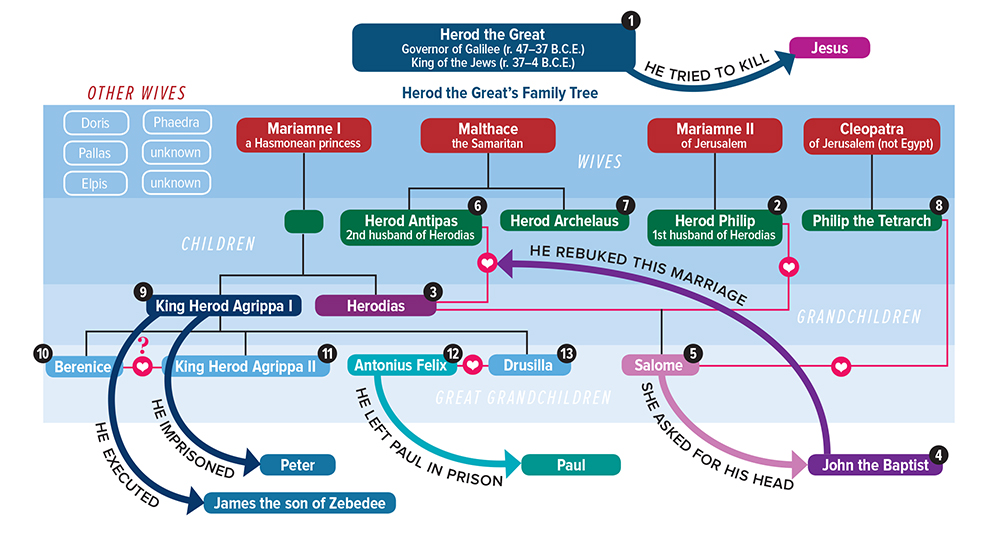
Herod Family Tree


https://www.biblicalarchaeology.org/wp-content/uploads/2017/09/herodian-family-tree.jpg


Psalm 116:15 hcsb

The death of His faithful ones is valuable in the Lord’s sight


William Kamkwamba - The Boy Who Harnessed The Wind


The Boy Who Harnessed The Wind | Offical Trailer [HD] | Netflix


https://youtu.be/nPkr9HmglG0

Rev 3: 14 Laodicea 2-16-2023

        Archaeological site of Laodicea on the Lycus between Pamukkale and Denizli, Turkey. The photo shows the Syria Street.       To the ...